|
| ISLANDS A-Z | CRETE | CYCLADES | DODECANESE | EASTERN AEGEAN |
| IONIAN | SARONIC | SPORADES | MAINLAND | ABOUT US |
Mesta – a medieval labyrinth on Chios |
 |
|
Mesta (population about 300) is one of the most beautiful villages on Chios and one of the most unusual villages I have stayed in anywhere in Greece. I spent a week here and used Mesta as a base for excursions around southern Chios. But what I remember most vividly is not the excursions, but the village itself.
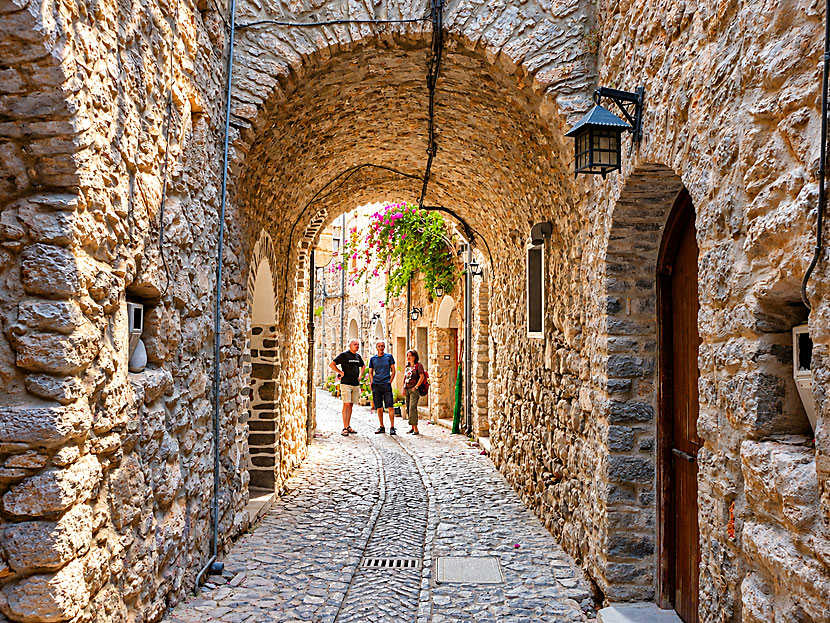
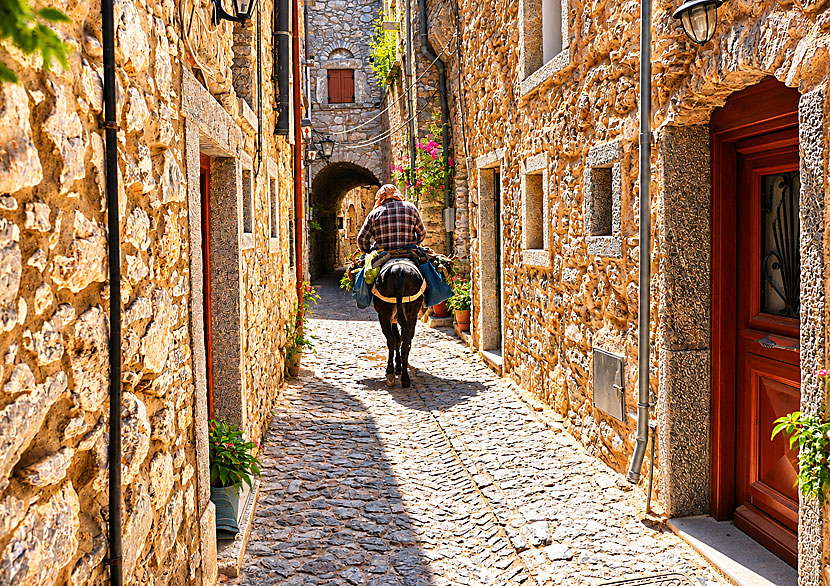
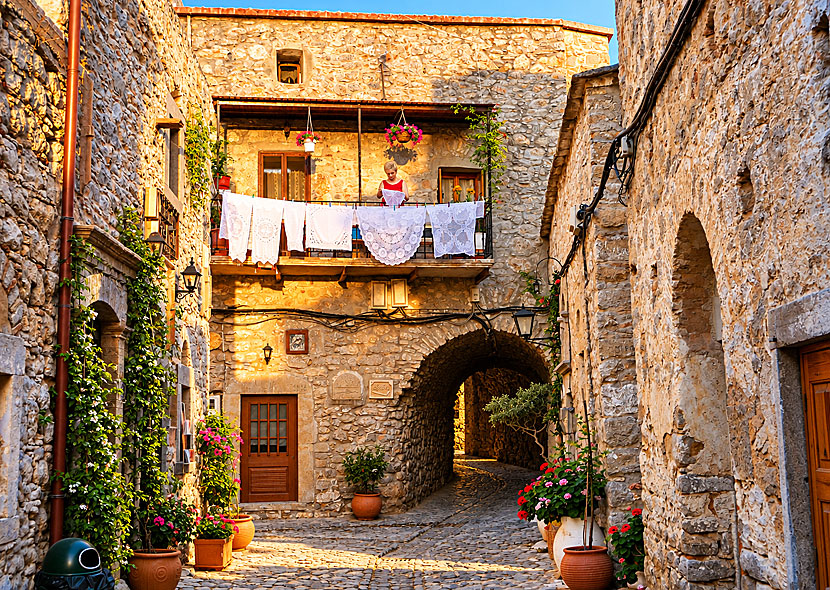
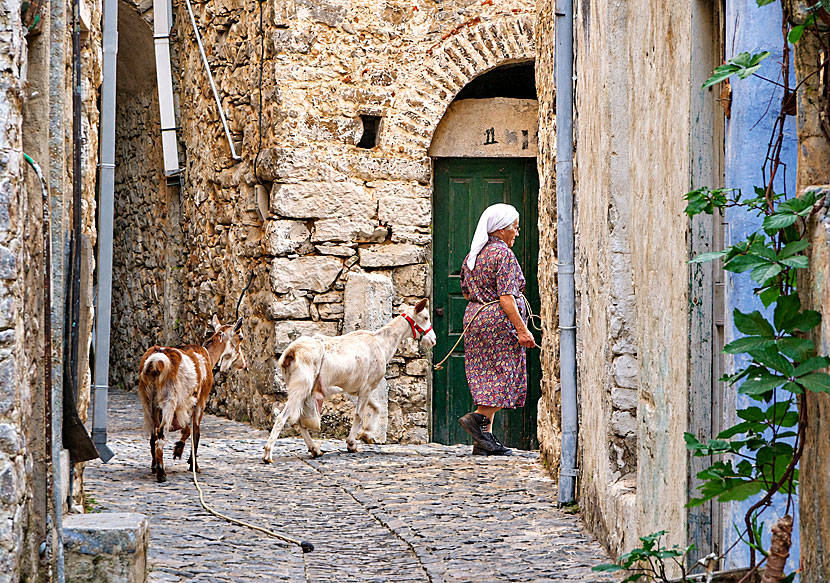
One of the many labyrinthine alleys in Mesta.
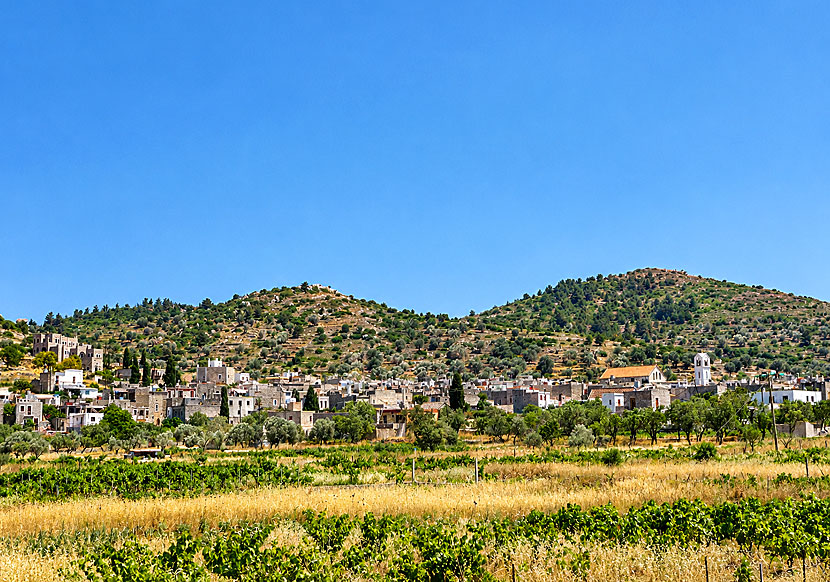
Mesta is located about 35 kilometres southwest of Chios Town and is one of the Mastichochoria, the mastic villages in the southern part of the island. It is one of the best-preserved medieval villages on Chios and is protected as a historic monument. The village architecture has its roots in Byzantine times, while the fortifications were later strengthened during the period of Genoese rule on Chios.
The medieval village of Mesta.
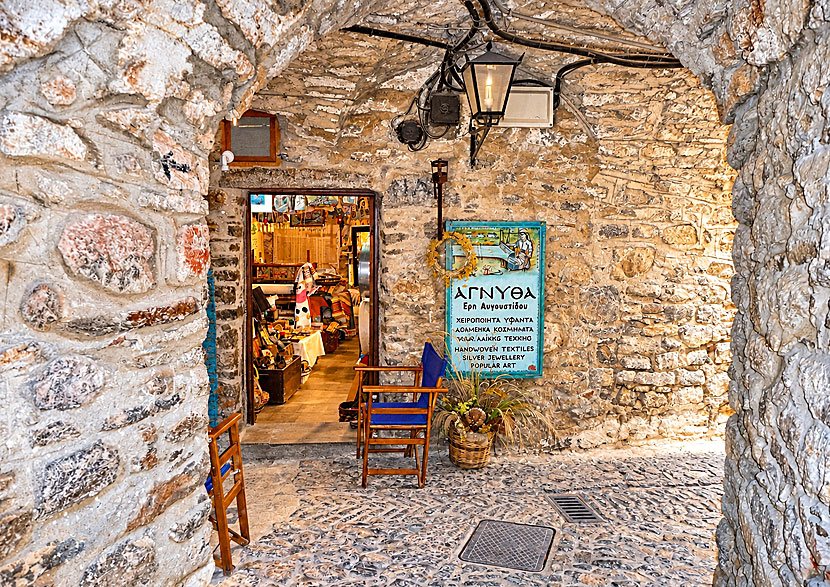
You soon realise, even before you have ventured very far into Mesta, that this is no ordinary Greek village. There are no straight village streets and hardly any open spaces. Instead, you find a maze of narrow alleys, arches, tunnel-like passageways and tall stone houses. It is very easy to get lost. And that is part of the charm. In many places in the village, it feels like being indoors. It is absolutely fantastic!
Mesta was built like a fortressThe houses in Mesta were built very close together. The outer walls of the houses formed a strong defensive wall around the village. In this way Mesta took the shape of a fortress, with an approximately pentagonal layout. In several places the alleys pass beneath arches, with houses continuing above them. The labyrinthine layout was no coincidence. It made it much harder for attackers and pirates to quickly reach the centre of the village.
The large gate known as Kapetanou Porta is the main entrance to Mesta.
Originally there were only two entrances to the fortified village. The large iron gate known as Kapetanou Porta, the Captain’s Gate, was the main entrance. I only remember that particular gate myself, and perhaps that is not so surprising. Walking through it really gives you the feeling of entering an old fortress.
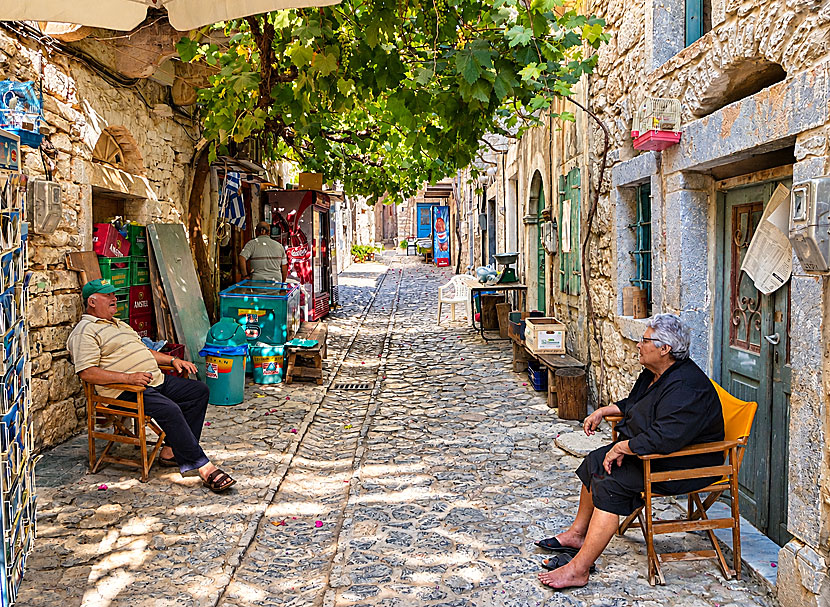
Everyday Greek life still dominates in Mesta. |
Get lost in the alleysThe best thing to do in Mesta is simply to start walking. You
turn a corner, pass beneath an arch and continue into another narrow alley.
Sometimes it almost feels as though you are walking straight into someone’s
home. A little later you emerge into a small open space and think you
know where you are. Usually you don’t.
In Mesta it sometimes feels as though time has stood still.
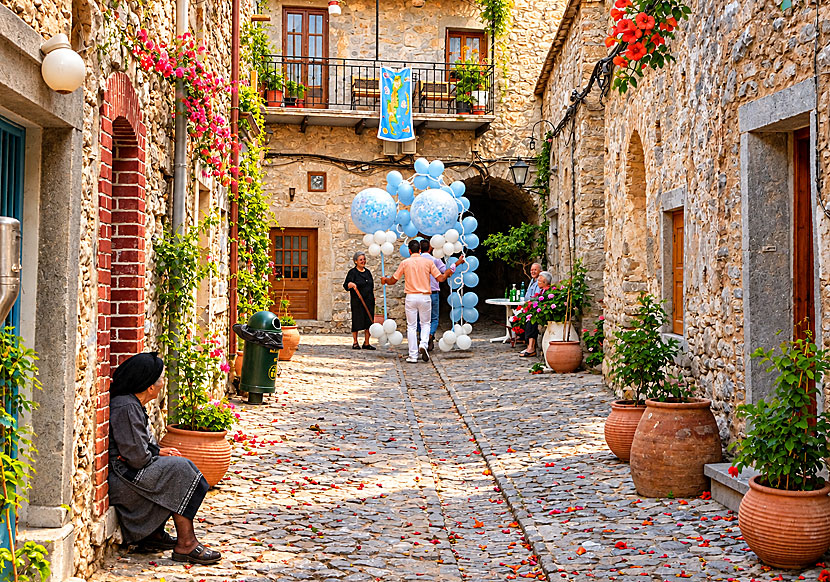
Preparations for a baptism in Mesta.
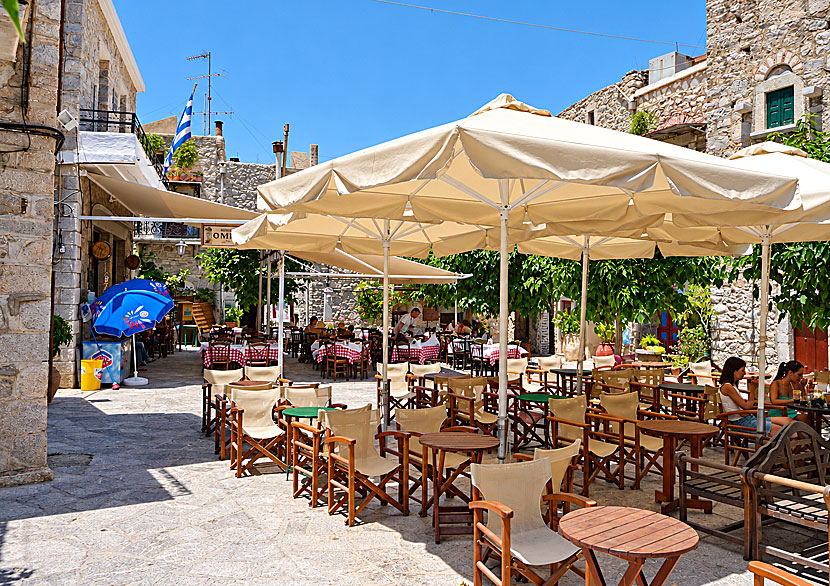
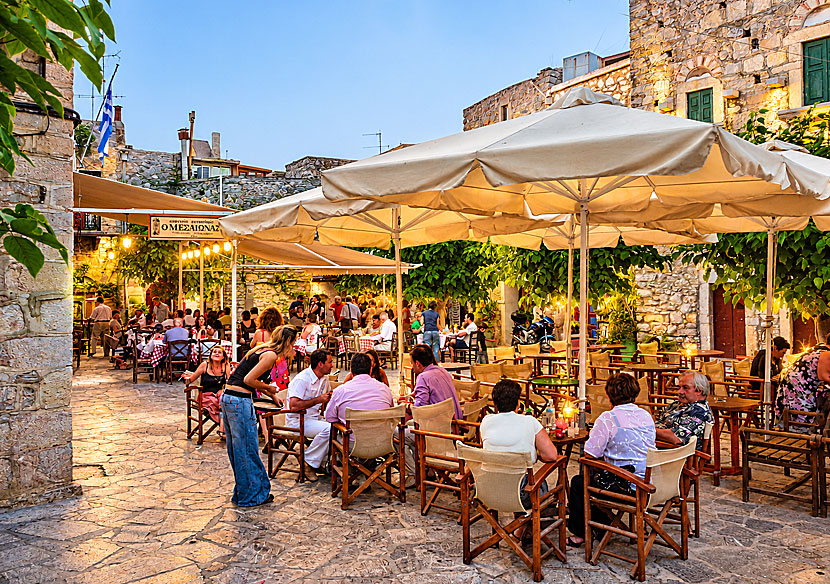
The square in the middle of the labyrinthSooner or later you arrive at the central square. The contrast with the narrow and rather dark alleys is striking. Suddenly the village opens up, and here you find cafés and tavernas beneath the trees. If you are only visiting Mesta for a few hours, the square is a pleasant place to sit down for a while. When you stay in the village, it becomes something else. You pass through the square in the morning, return in the afternoon and somehow end up there again in the evening. After a few days it almost feels like your own living room.
Restaurant and café on the square in Mesta.
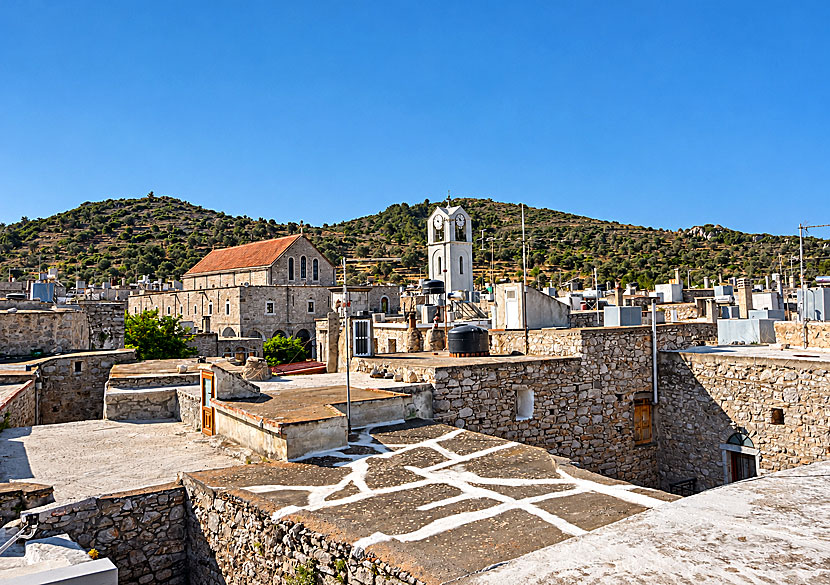
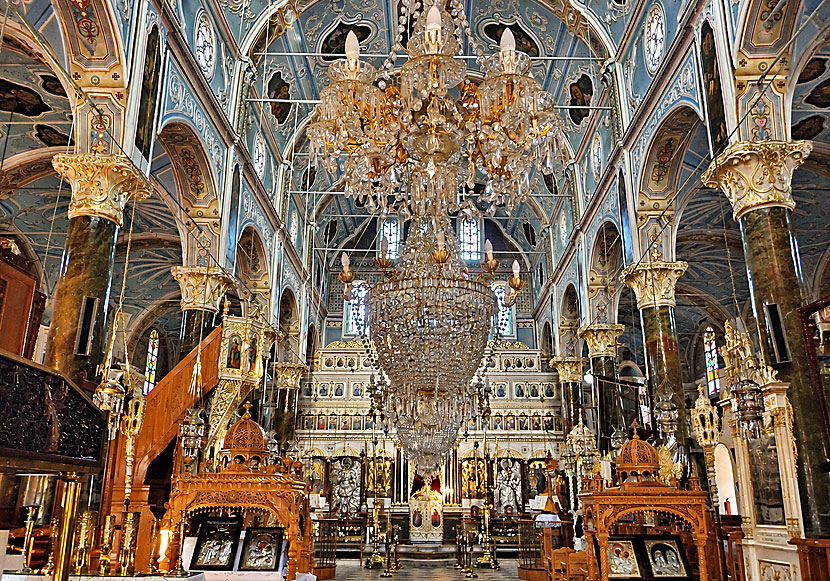
Beside the square stands the large church of Megalos Taxiarchis, which was completed in 1868. It was built on the site where the village’s central defensive tower once stood There is also an older Taxiarchis church, Palios or Mikros Taxiarchis, hidden among the alleys. It is considerably smaller and has beautiful wood carving, a fine example of the wood-carving tradition for which Chios is known.
Megalos Taxiarchis church in Mesta.
The interior of Megalos Taxiarchis is extraordinarily beautiful. |
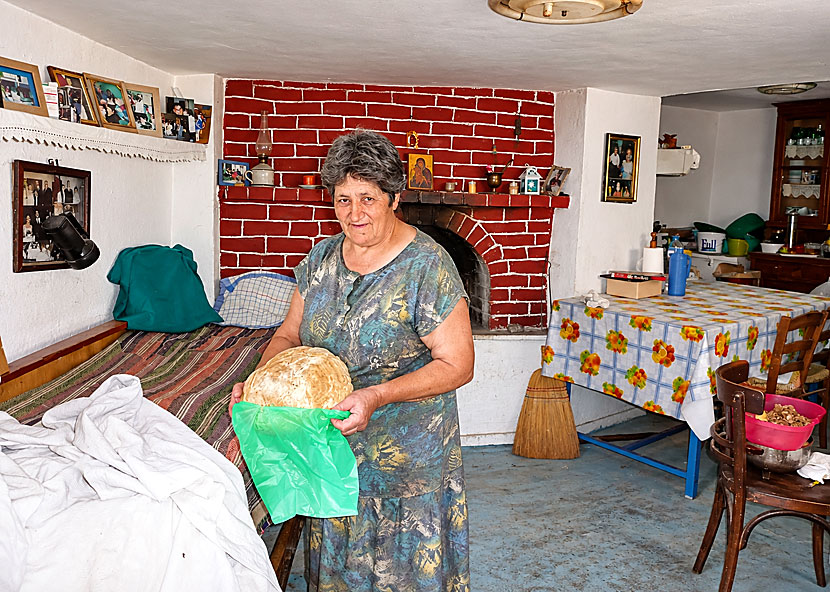
The bakery I will never forgetWhen I stayed in Mesta there was a small bakery inside the old village that looked as though it belonged to another age. I can still remember the woman standing there with flour on her clothes and a large loaf of freshly baked bread in her hands. Behind her was the masonry oven, and the whole place looked almost more like someone’s living room than a shop. It was one of those little experiences you could never have planned in advance, yet years later it becomes one of your strongest memories from a journey. I don’t know if the bakery still exists today. But I will never forget it.
The old bakery I will never forget. The bread was divinely good.
A village in the heart of mastic countryMesta lies in the part of Chios where the famous mastic is cultivated.
Mastic comes from the mastic shrub, and it is here in southern Chios that
this special form of cultivation developed. Mesta is one of the villages
collectively known as the Mastichochoria. Since 2014, the traditional
knowledge of cultivating and harvesting mastic on Chios has been included
on UNESCO’s list of the Intangible Cultural Heritage of Humanity.
When you drive around south of Mesta you see mastic shrubs everywhere,
and it becomes easier to understand why these particular villages were
so important and why they needed protection.
A shop in Chios Town selling products made from mastic resin.
Mastic is a shrub that grows throughout the Mediterranean region,
but Chios is the only place where its resin is used in this particular
way. It is said that the mastic shrubs on Chios have special properties
that distinguish them from shrubs growing elsewhere in the Mediterranean.
What is more, only the shrubs growing in southern Chios are useful for
producing the famous resin. Strange, isn’t it? The resin is said
to have healing properties and is used in a wide variety of products,
including cosmetics, chewing gum, spices, spirits, wine, jam, juices,
marmalades and sweets. An excellent base for exploring southern ChiosMesta is also an excellent base if you want to explore southern Chios. The other major medieval fortress village, Olympi, is nearby, and not far away lies Pyrgi, which is completely different from Mesta with its famous black-and-white geometric patterns decorating the façades. Several beaches and small coves along the southern and western coasts of Chios are also within easy reach of Mesta. Mesta’s own harbour lies down on the coast a few kilometres from the village and is called Limenas Meston. But for me, one of the best things about staying here was that every excursion ended in exactly the same way: I got to come back to Mesta.
The black-and-white village of Pyrgi lies close to Mesta.
Read more about Pyrgi here »Mesta in the eveningI think Mesta is at its very best in the evening. The day visitors disappear, the alleys become quiet and the lamps beneath the stone arches are switched on. Voices drift across from the square, and every now and then someone appears in an alley that was completely empty only a few seconds earlier. At moments like these it is difficult not to think about all the people who have walked through the same alleys over the centuries.
The square in Mesta in the evening.
Mesta is certainly worth visiting as a day trip. But if you have the opportunity, I recommend doing something many visitors never do: Stay overnight. Better still, stay for a few nights. Because Mesta is one of those Greek villages that gets better the longer you stay.
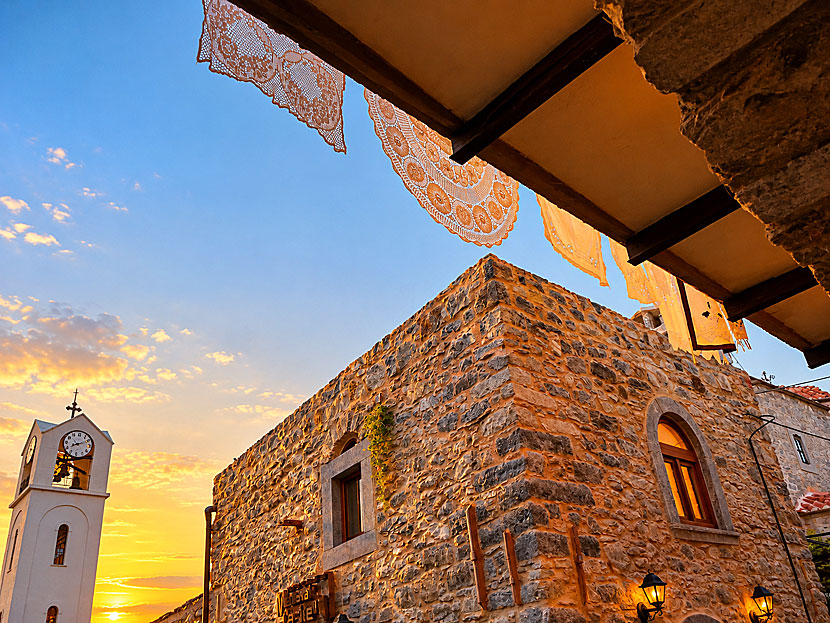
Mesta is an extremely photogenic village.
Sunset by Megalos Taxiarchis church in Mesta. |
Outside the old villageMesta is not only the medieval labyrinth inside the old defensive walls.
Outside the fortified part there are more modern buildings, and when we
stayed here there were several tavernas and a few small shops.
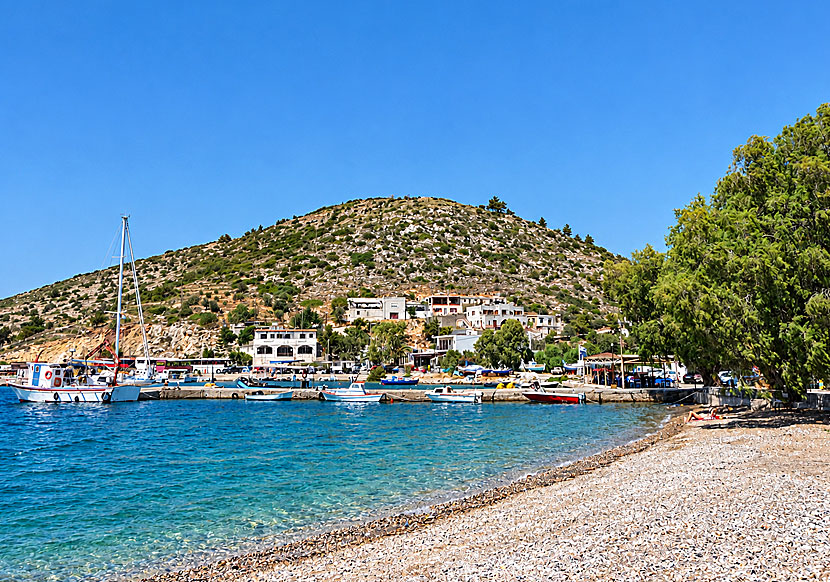
Limenas Meston harbour and beach are about 3–4 kilometres from Mesta.
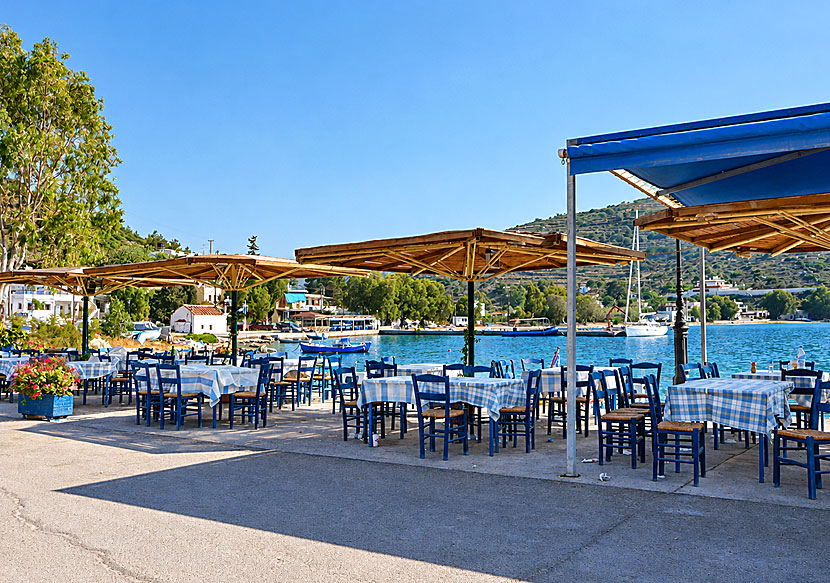
Limenas Meston – the harbour of MestaMesta is not situated by the sea, but it has its own harbour a few kilometres away. It is called Limenas Meston and lies on the west coast, about 3–4 kilometres from the medieval village. The harbour is also used by larger ships, but there are small boats here too, as well as tavernas and a small pebble beach.
|
HOME |
ABOUT US |
SEARCH |
BOOK HOTEL |
GREEK ISLANDS |
SWEDISH
|
|
© 2007-2026 | Janne Eklund | Kalispera and Kalimera. |